



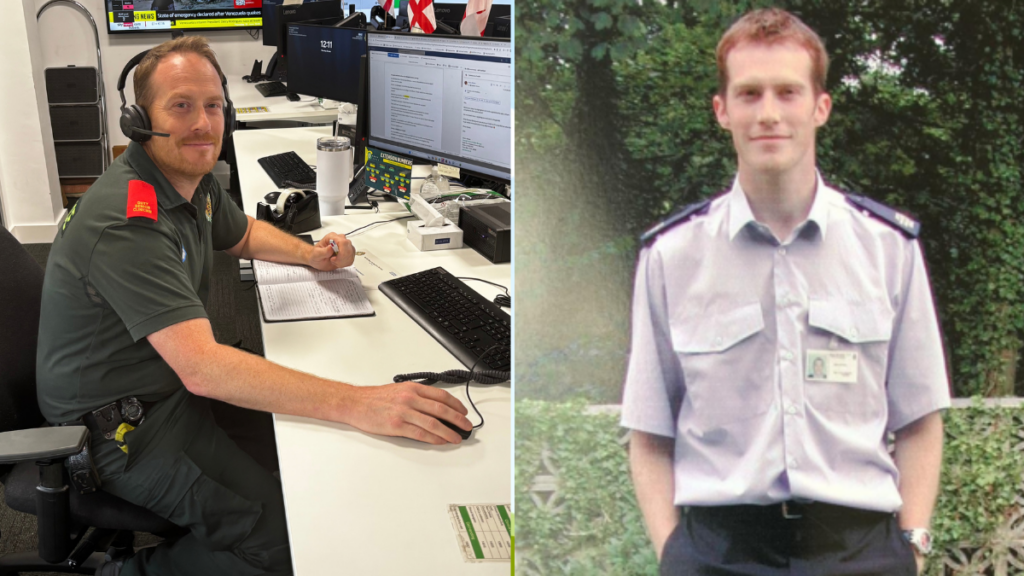
In fact, as a teenager, he had little idea what he wanted to do.
“I drifted through school and college,” Jon reflects. “I never really knew what career I wanted.”
After leaving education, he completed a three-year business apprenticeship, but quickly realised it wasn’t the right fit.
“I just wasn’t enjoying it. I knew it wasn’t what I wanted to do long term.”
Then, at 22 years old, everything changed.
While browsing a local newspaper, Jon spotted an advertisement for student paramedics with Greater Manchester Ambulance Service (GMAS).
“It was like somebody flicked a switch,” he says. “As soon as I saw it, I knew that’s what I wanted to do.”
He applied, was successful, and in 2001 began what would become a 25-year career dedicated to helping patients across the North West.
“I’ve never looked back.”
Joining a changing profession
Jon joined GMAS as part of a large recruitment campaign at a time when the ambulance profession was beginning to evolve into the modern service we recognise today.
Although recruited as a “student paramedic”, the role initially involved working as an ambulance technician before progressing to paramedic training.
After two years on the road, Jon attended the residential paramedic programme at Ladybridge Hall, where he spent 12 weeks training before qualifying as a paramedic.
From there, he built a varied career across frontline operations, progressing through a number of clinical and leadership roles.
His journey has included working as a RRV paramedic, completing a three-year secondment as a clinical practice trainer, becoming a senior paramedic and later an advanced paramedic. In 2025, he took up his current role as duty senior clinician within the ICC.
Today, Jon provides clinical oversight for patients accessing services through both 999 and NHS 111, while still maintaining frontline clinical shifts as an advanced paramedic.
“It was important to me that I could continue seeing patients,” he explains. “One of the reasons I took the role was that I still get to spend time out on the road each week.”
From GMAS to NWAS
Having joined GMAS in 2001, Jon was already an established clinician when NWAS was formed in 2006 through the merger of four local ambulance trusts.
“It was clear we’d become part of something much bigger,” he recalls.
Before the merger, crews rarely crossed county boundaries and often worked almost exclusively within their local areas.
“We were so close geographically, but we didn’t really know how other services operated. Suddenly there was an opportunity to learn from different ways of working and see how ambulance services across the region operated.”
Looking back, Jon believes the merger was an important and positive step forward.
A career full of opportunities
One of the reasons Jon has remained with NWAS for a quarter of a century is the variety of opportunities available throughout the organisation.
“I’ve always enjoyed the work of a paramedic and I’ve never lost that enthusiasm for going out and helping people.”
He credits NWAS with providing opportunities for continuous development throughout his career.
“Every time I’ve wanted a new challenge, there’s been an opportunity to learn something different or progress into a new role. I’ve never felt bored and I’ve never really felt the need to look elsewhere.”
The service has also become a community in its own right.
“The people you work with become your friends for life. It becomes more than a job, it becomes part of who you are.”
Learning never stops
Among Jon’s proudest achievements is completing both a Bachelor’s degree and a Master’s degree with distinction while working within the service.
“University was never something I’d done when I was younger, so achieving those qualifications later in my career is something I’m really proud of.”
But it is patient outcomes that remain closest to his heart.
Over the years, Jon has received countless letters informing him that patients he treated following cardiac arrests have survived and returned home to their families.
“Knowing there are people walking around today because of the difference we’ve made as a team, that’s something you can never stop being proud of.”
How ambulance care has changed
During Jon’s 25 years in the profession, ambulance care has transformed beyond recognition.
“When I first started, we didn’t even carry morphine,” he laughs. “We certainly didn’t have some of the medications and interventions that crews have access to today.”
Technology has also revolutionised patient care.
“When I joined, our defibrillators couldn’t perform a 12-lead ECG. We couldn’t identify heart attacks in the way we can now.”
Even navigating to incidents looked very different.
“We didn’t have satnavs. If you got a job, your crewmate would be reading directions from an A-Z map book while you drove.”
The wider healthcare landscape has evolved too, with specialist stroke centres, major trauma centres and enhanced care pathways now ensuring patients receive the right treatment more quickly than ever before.
For Jon, one of the biggest developments has been the rise of advanced paramedic practice.
“The level of advanced care paramedics can now provide simply wasn’t imaginable when I started. To have seen that develop and then become part of it has been a real privilege.”
Looking ahead
As NWAS celebrates its 20th anniversary, Jon believes the future will focus on ensuring patients receive the right care at the right time.
He expects continued advances in medicines, technology and specialist clinical roles, alongside greater emphasis on ensuring ambulances are sent to those patients who truly need hospital-based care.
“We’ll keep evolving, just as we always have.”