



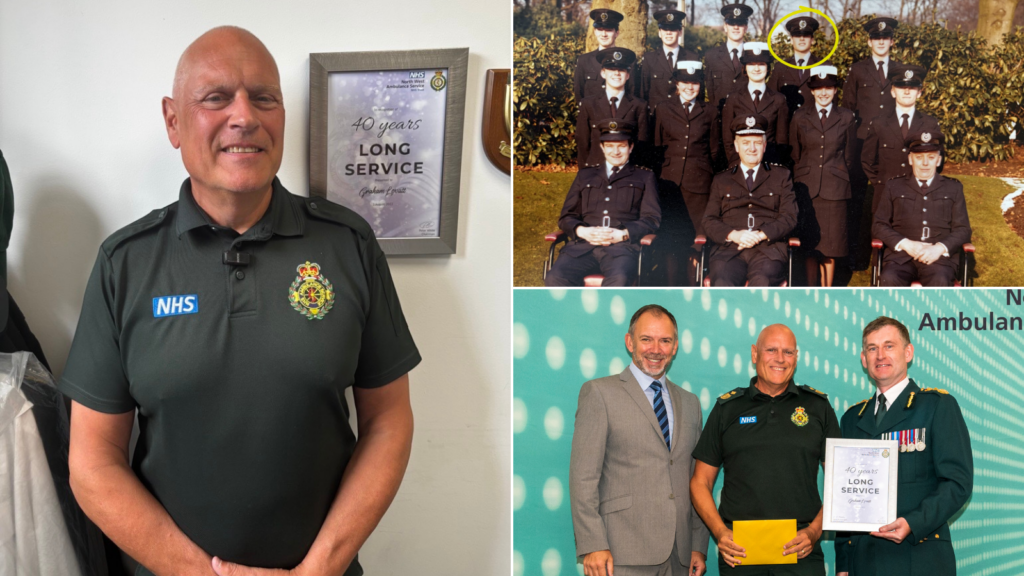
This September marks an incredible 45 years of service for Graham, a career that has spanned generations, roles and the evolution of ambulance care itself.
Graham joined the service straight from school as a cadet at just 16 years old. “It was a completely different world,” he recalls. “We lived on site at Ladybridge Hall in Bolton during training, dormitories upstairs, classrooms downstairs. You’d be there Monday to Friday and go home at weekends.”
The cadet scheme saw Graham rotate through different parts of the service over two years, from stations to fleet and headquarters, before qualifying as an ambulance technician. “It was hands-on from the start. You learned everything by doing.”
Over the years, Graham has worked in around 10 different roles, including paramedic, supervisor, trainer, control manager and various operational leader positions across the area. He now works as Head of Regional Planning, using data and insight to help decide how ambulance crews and resources are used across the North West to meet demand and support performance. He also maintains roster systems. “I’ve been lucky,” he says. “I’ve had a varied career and taken opportunities as they came.”
His journey has taken him across the region, from Ashton and Middleton to Manchester city centre, Oldham, Cumbria and Lancashire, even stepping in at short notice to lead services where needed. “It wouldn’t happen like that now,” he laughs. “One day I was asked if I could cover the sector management position in Blackpool, the next day I was there being handed the keys.”
Graham has seen first-hand how ambulance care has transformed over the last four and a half decades. “When I started, we didn’t have defibrillators on vehicles, no paramedics, no lifting aids, no sat nav, just a street index book. Everything was manual,” he explains. “You had a small black satchel with basic equipment on the vehicle, that was it.”
Today’s crews benefit from advanced clinical education/training, digital technology and specialist pathways for patient care. “You can now access patient records, get clinical advice and make more informed decisions.”
As sector manager, Graham successfully introduced the paramedic team based at Manchester Airport, which has been running for many years.
Across such a long career, some moments inevitably stand out. “You always remember your firsts. Your first baby delivery, your first cardiac arrest, your first job as a paramedic.”
Graham estimates he helped bring around 11 babies into the world during his time on the road. There have also been challenging incidents. Major trauma, serious violence and large-scale public disorder (Moss Side, Strangeways and Oldham riots) plus the Manchester Arena attack and COVID-19, which, as everyone knows, were very challenging periods. “You see a lot over the years, but you can still learn something new every day,” he says. “Some jobs stay with you more than others. I also covered sporting and music events as a paramedic and commander, like the Commonwealth games, Parklife and Premier League football games – it’s very rewarding.”
But it’s the successes that stand out most. “You remember the ones you bring back, the patients who survive.
“I’m also very proud to have received many medals over the years, including the Queen’s Long Service and Good Conduct medal, and to have completed my Master of Business Administration (MBA).”
The ambulance service didn’t just shape Graham’s working life; it also shaped his personal life. “I met my wife Karen through the job,” he says. “For over 38 years, she has worked for the service as an ICC dispatcher. I am very proud of her, as she has had a more stressful job for many years.”
Together, they’ve raised two daughters, Natalie and Amy, of whom they are very proud. “Without the love and support from my family, I would not have been able to do the things I have done (especially completing my MBA) and I will always be grateful to them.”
Ask Graham what has mattered most over 45 years, and the answer is simple: “The people. It’s always been about the people you work with.”
From training new starters as a work-based assessor to leading teams across the region, supporting colleagues has been a constant throughout his career. “You help people develop, guide them and watch them grow in the service. That’s a big part of it. You also make lifelong friends, many have already retired, but we meet up regularly and recall the good old days.”
Graham believes the future of ambulance care will be shaped by technology and new ways of treating patients. “There’ll be more digital support, more use of data and more options for where patients can go, not just A&E. Community care will play a bigger role, I hope.”
Looking back on 45 years of service, Graham is clear about what it all means. “I’ve enjoyed every role I’ve done. There have been ups and downs, but overall, it’s been a great career.”
And his advice for anyone starting out today? “Embrace it. Take every opportunity you can and enjoy it.”