



Last August, David Roberts was enjoying an afternoon with family and friends when he choked on a piece of food and suddenly collapsed. “That’s really the last thing I remember,” he says. “Other than waking up later in the coronary care unit, having been treated by amazing paramedics and hospital staff.”
For his wife Nicola, the moment is etched into memory. “One minute we were chatting and eating, and the next David just completely fell,” she recalls. “We thought he was choking. We tried to help, but he was unresponsive. It was terrifying.”
As panic spread, a 999 call was made. On the line, calm call handler Jessica, quickly took control instructing Nicola to begin CPR. Having completed basic life support training in the past, Nicola found herself relying on skills she never imagined she would need. “It just came back automatically,” she says. “She kept me focused and talked me through it until help arrived.”
That help came from our ambulance crews: paramedics Francesca and Tony, and Emergency Medical Technician Chloe.
Francesca was among the first clinicians to arrive. “Nicola was doing an incredible job of CPR when we arrived,” she says. “It’s an incredibly intense situation, but those early actions really mattered.”
As the emergency teams worked to secure David’s airway and restart his heart, they were supported by a crew from the Great North Air Ambulance Service and volunteer doctor responder Theo, who works for the organisation BEEP Doctors, which can be sent to bring hospital-level treatment directly to patients.
“Within a short space of time, we managed to get David’s heart working again in a normal rhythm,” Theo explains. “Our role at that stage was to provide advanced critical care — including sedation, ventilation and medication, to stabilise him safely before transfer to hospital.”
“To see David here today, alive, well and back to normal life, is exactly why we do this,” Theo says.
For David, the months that followed were about more than physical recovery. “I was sedated, I was in a coma, so there were lots of missing pieces,” he explains. “It’s been a journey of discovery, finding out what actually happened.”
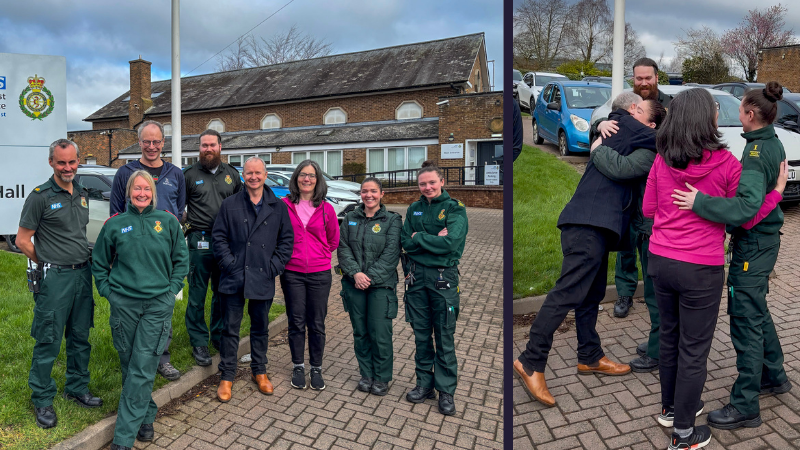
That journey came full circle at a reunion in Carlisle, where David and Nicola were reunited with some of the people involved in his care. “Being able to say thank you in person was incredibly important,” David says. “To meet the people who saved my life and to know some of them volunteer their time, it really means everything.”
Now, the couple are encouraging others to learn CPR, sharing a message shaped by experience: knowing what to do in those first few minutes can save a life.
For David, it gave him a second chance.
This story is taken form our Your Call magazine.