



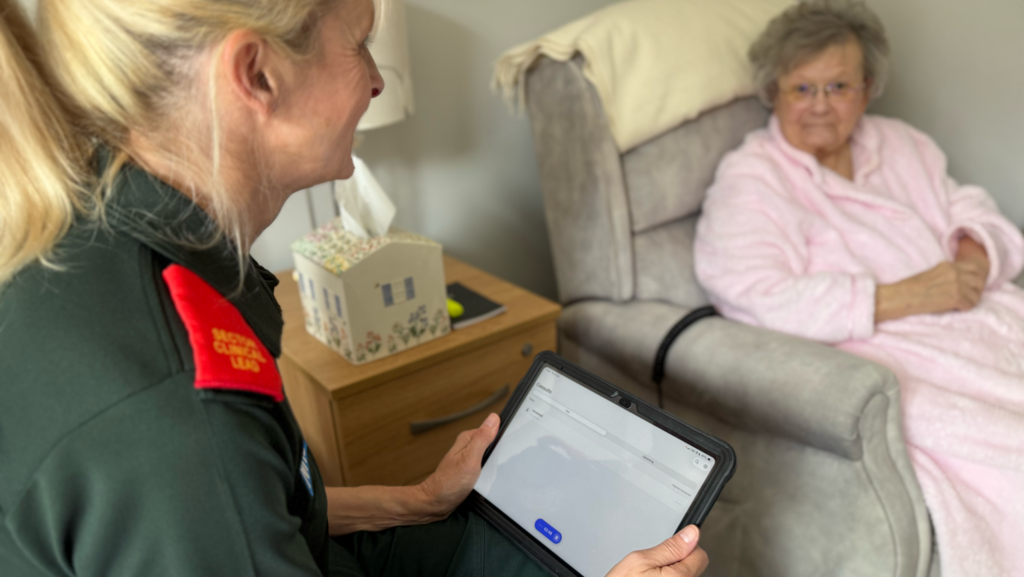
Ambient Voice Technology securely listens to conversations between patients and clinicians and turns them into standardised clinical notes for the crews to verify before being added to the patient record.
The timely trial is being extended following an eight-week proof of concept involving 40 of our frontline clinicians earlier this year, which showed the technology was clinically safe. This next stage sees the AVT being made available to more crews on the road, and within the first few weeks, they are already closing in on 25% of on-the-road staff signing up. As the NHS enters its traditionally busy winter period, this technology is expected to provide extra support to staff while demand is high.
NWAS Chief Information Officer Jenny Wharton says, “Our staff are very excited by this development. Providing accurate patient notes is an important part of the job, but it is time-consuming. This tool aims to make that job easier while maintaining data governance and patient safety. Before any notes are submitted to the patient record, the clinician must check them for accuracy and completeness. We think this could be a great tool for our colleagues. Giving them the ability to focus on their patients and the care they give.
“For the next few months, we want as many of our colleagues as possible to try it and to understand the true benefits.”
Feedback has been very positive, with clinicians saying they spent less time completing documentation and, as a result, felt less fatigue and improved wellbeing. It also provided an opportunity to focus more of their attention on patients rather than being distracted by writing notes.
One duty officer said, “After I used the app for the first time, I have to say I’m genuinely impressed. As someone with dyslexia, I’ve found it makes taking patient histories significantly easier. It’s arguably the most valuable addition to my clinical practice in years, and it’s got me thinking about how the technology could be applied more widely.”
While the technology uses a pre-existing large language model (LLM), our own development team have designed and adapted the prompts that convert the information into the desired output. In essence, they’ve worked out how to turn a verbal consultation into a written patient record that fits a standardised template on a consistent basis.
Patient privacy has also been considered. Audio is transmitted to a UK-based server for live transcription and deleted immediately once it has been successfully transcribed. The transcript and saved note are deleted after 24 hours. Clinicians are required to explain to the patient, where practicable, that the app is being used and address any concerns and questions. Patients can request that AVT is not used, and it’s also optional for staff to use as well.
The extended trial is due to last until the end of May 2027, after which we will look at next steps ahead of a potential full roll-out.