

Skip navigation
North West Ambulance Service (NWAS) logo
  • News
  • Events
  • Charity
  • Ambulance Academy
  • Publications
Use this link to enable the ReciteMe accessibility toolkit Enable ReciteMe accessibility tools
  • Home
  • Our service
    • Urgent and emergency care (999)
    • NHS 111 (non-emergency)
    • Patient Transport Service (PTS)
    • Major incidents
    • Emergency advice
    • Information for professionals
    • Other ways we can help
    • Help accessing our services
    Need to arrange transport using our Patient Transport Service (PTS)?
  • Get involved
    • Your Call Magazine
    • Volunteer with us
    • Support the North West Ambulance Charity
    • Support our campaigns
    • Children and young people
    • Lifesaving skills
    • Events
    • Share your experience
    • What happens with your feedback?
    • Talk to us on social media
    Need to arrange transport using our Patient Transport Service (PTS)?
  • About us
    • Our publications
    • Who we are
    • Our locations
    • How we are doing
    • Board of directors
    • Equality, diversity and inclusion
    • Research and development
    • Public Health
    • Information for suppliers
    Need to arrange transport using our Patient Transport Service (PTS)?
  • Careers
    • Our assessment centre
    • Current vacancies
    • Join our team
    • Why work with us
    • Explore roles
    • Applying for a job
    • Working with the Armed Forces
    Need to arrange transport using our Patient Transport Service (PTS)?
  • Contact us
    • Media
    • Request my information
    • FOI and EIR
    • General enquiries
    • Lost property
    • Make a complaint
    • External Patient Event Reporting Form
    • Point taken
    • Send a thank you
    • Tell us how we did
    Need to arrange transport using our Patient Transport Service (PTS)?
  • Home
  • Our service
    • Urgent and emergency care (999)
    • NHS 111 (non-emergency)
    • Patient Transport Service (PTS)
    • Major incidents
    • Emergency advice
    • Information for professionals
    • Other ways we can help
    • Help accessing our services
    Need to arrange transport using our Patient Transport Service (PTS)?
  • Get involved
    • Your Call Magazine
    • Volunteer with us
    • Support the North West Ambulance Charity
    • Support our campaigns
    • Children and young people
    • Lifesaving skills
    • Events
    • Share your experience
    • What happens with your feedback?
    • Talk to us on social media
    Need to arrange transport using our Patient Transport Service (PTS)?
  • About us
    • Our publications
    • Who we are
    • Our locations
    • How we are doing
    • Board of directors
    • Equality, diversity and inclusion
    • Research and development
    • Public Health
    • Information for suppliers
    Need to arrange transport using our Patient Transport Service (PTS)?
  • Careers
    • Our assessment centre
    • Current vacancies
    • Join our team
    • Why work with us
    • Explore roles
    • Applying for a job
    • Working with the Armed Forces
    Need to arrange transport using our Patient Transport Service (PTS)?
  • Contact us
    • Media
    • Request my information
    • FOI and EIR
    • General enquiries
    • Lost property
    • Make a complaint
    • External Patient Event Reporting Form
    • Point taken
    • Send a thank you
    • Tell us how we did
    Need to arrange transport using our Patient Transport Service (PTS)?

Search the site

  • Home
    • Urgent and emergency care (999)
    • NHS 111 (non-emergency)
    • Patient Transport Service (PTS)
    • Major incidents
    • Emergency advice
    • Information for professionals
    • Other ways we can help
    • Help accessing our services
    Need to arrange transport using our Patient Transport Service (PTS)?
    • Your Call Magazine
    • Volunteer with us
    • Support the North West Ambulance Charity
    • Support our campaigns
    • Children and young people
    • Lifesaving skills
    • Events
    • Share your experience
    • What happens with your feedback?
    • Talk to us on social media
    Need to arrange transport using our Patient Transport Service (PTS)?
    • Our publications
    • Who we are
    • Our locations
    • How we are doing
    • Board of directors
    • Equality, diversity and inclusion
    • Research and development
    • Public Health
    • Information for suppliers
    Need to arrange transport using our Patient Transport Service (PTS)?
    • Our assessment centre
    • Current vacancies
    • Join our team
    • Why work with us
    • Explore roles
    • Applying for a job
    • Working with the Armed Forces
    Need to arrange transport using our Patient Transport Service (PTS)?
    • Media
    • Request my information
    • FOI and EIR
    • General enquiries
    • Lost property
    • Make a complaint
    • External Patient Event Reporting Form
    • Point taken
    • Send a thank you
    • Tell us how we did
    Need to arrange transport using our Patient Transport Service (PTS)?
  • News
  • Events
  • Charity
  • Ambulance Academy
  • Publications
Home > News > Announcements > Connecting care beyond the call: social prescribing

Connecting care beyond the call: social prescribing

Posted 12th November 2025

Share this page
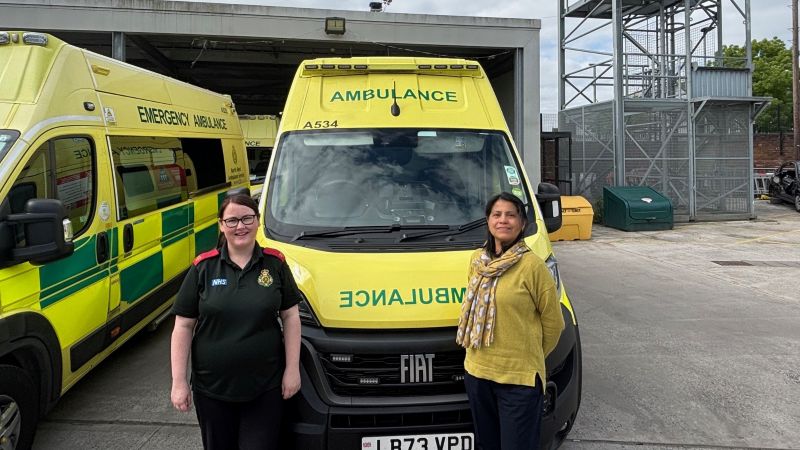
Sector Clinical Lead Natalie and Public Health Manager Claudia stood in front of an ambulance.

When the blue lights fade and the emergency is over, the challenges many of our patients face don’t stop. Loneliness, housing issues, money worries, and lack of community support can still impact their health; it might even be the reason they called 999 in the first place.

That’s where social prescribing comes in. It’s a simple but powerful idea: connecting people with local, non-medical support to improve their overall wellbeing. Think benefit advice, debt counselling, help with cold or damp homes, community groups, or simply someone to talk to. And it’s not just for GP surgeries anymore. Social prescribing is part of our wider efforts as an ambulance service to provide high-quality, person-centred care to our patients.

Our social prescribing initiative is championed by Public Health Manager Claudia Soiland-Reyes and in Greater Manchester by Sector Clinical Lead Natalie Ashcroft.

Natalie has worked in Team NWAS for 12 years, starting as a student paramedic and progressing to an advanced clinical role. Despite having dyslexia, Natalie was determined to pursue her dream. With the support of her university family, friends, and a lot of determination, she successfully gained her diploma and paramedic registration. Since then, she has completed her Master of Science in advanced practice.

“I always wanted to be a paramedic,” Natalie shares. “I love helping people and working in environments where you have to think on your feet.”

Claudia has worked with us for two years. Originally from Mexico, Claudia has lived and worked in the UK for half of her life. She did her master’s degree in mathematics and statistics, with a focus on practical methods to optimise resources. She has worked in health services research for over 10 years.

Claudia shares, “My dad worked in the Mexican Social Security Institute, a similar government organisation to the NHS, so having the opportunity to work at the NHS, I feel proud of following his steps.”

The duo is now collaborating with colleagues to help improve how ambulance crews support patients, long after the initial emergency.

Claudia explains, “Social prescribing is a way to help patients with issues that affect their health but aren’t necessarily medical. Things like housing problems, isolation, or financial stress. These can’t be solved with medicine, but they impact someone’s health. We connect people to the support already available in their communities. It’s about treating the whole person, not just the symptoms.”

Traditionally, social prescribing referrals were made by GPs. However, ambulance crews often visit patients in their own homes, giving them a unique insight into the daily struggles people face.

“The Public Health team began looking at social prescribing during the pandemic, with a pilot in Bolton, Greater Manchester, in partnership with Age UK. It’s now active across much of Greater Manchester, Cumbria, and Lancashire, and continues to expand. Our clinicians can now refer patients directly to social prescribing services 24/7, 365 days a year across these areas of the North West.”

“This gives us a real opportunity to make a difference,” says Natalie. “Sometimes, with just one referral, we can help stop a cycle that might otherwise lead to more 999 calls.

“The social prescribing service supports our wider strategies around health inequality, community care, and preventing repeat emergencies.”

Our crews can use Service Finder, which provides health and social care professionals with accurate and up-to-date information on available services within a specific locality through a mobile-friendly interface that is quick and easy to use. They can check if a patient’s area has a social prescribing pathway. Most referrals are processed through our Support Centre, with others being routed through local providers.

“Every area is slightly different,” explains Claudia. “That’s why we’ve worked hard to simplify the process so that frontline crews can act quickly, even during busy shifts.”

“From helping someone get essential heating repairs to connecting a lonely patient to a social group or tackling long-standing debt, the outcomes of a simple referral can be life-changing.”

Social prescribing not only helps patients, but it also helps the wider NHS. Reducing repeat 999 calls, lowering pressure on A&E, and offering long-term, sustainable support for those most in need. It’s a great example of how we can optimise and integrate resources by linking our patients to the services available and supporting them to take small steps to improve their health and wellbeing.

“We always prioritise our patient and their emergency,” Natalie says. “But we never lose sight of the person behind it, and social prescribing helps us support them beyond their call.”

This story was taken from the most recent edition of our Your Call magazine which is our digital publication for our patients, staff, volunteers, stakeholders, and the public. It explores our service initiatives, staff, patient, and public stories as well as current issues and other features. If you would like to be added to the mailing list or would like to contribute to our magazine, please contact our Communications Team at: [email protected].

Archive

  • 2025
  • 2024

Contact us

General enquiries

0345 112 0999 To call general enquiries, click this link or dial 0345 112 0999

This number should NOT be used to contact us in an emergency. In an emergency dial 999 immediately or for non-urgent medical advice call NHS 111.

How to find us

Directions to our offices

Alternative formats

Please contact us if you require any information on our website in an alternative format, such as easy read of large print.

CQC Good rating widget

  • Help
  • Privacy policy
  • Accessibility
  • Freedom of Information
  • Contact us
  • Green Room
  • Cookies

© Copyright 2025 North West Ambulance Service NHS Trust. Lovingly crafted by Mixd

Cookie settings

We use some essential cookies to make this website work. We’d like to set additional cookies to understand how you use nwas.nhs.uk, remember your settings and improve our services. We also use cookies set by other sites to help us deliver content from their services.
View cookies
You have accepted additional cookies. You can change your cookie settings at any time.
You have rejected additional cookies. You can change your cookie settings at any time.