



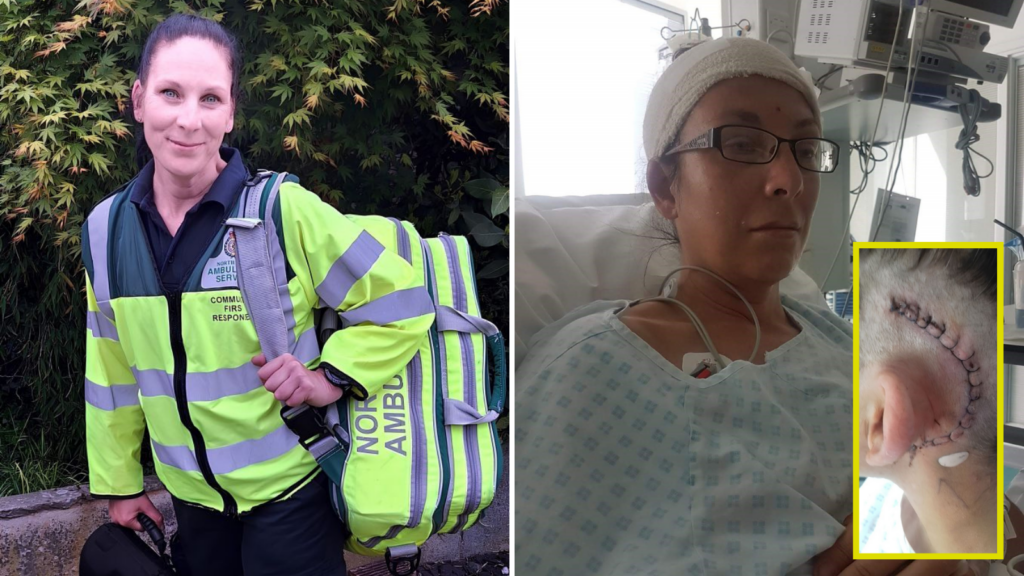
Sara says, “I honestly thought that was it for me. A death sentence.
“The only other person I had known with a brain tumour had died.” But what followed for Sara was not an ending; it was the start of something very different.
Sara, from Cheshire, had known for a while that something wasn’t right with her health. Fatigue and neurological symptoms led her to have investigations, and an MRI scan confirmed her diagnosis. “I knew something was wrong from the reaction of the staff. I was called back the same day and told I had a brain tumour. My shock quickly turned to fear, and I remember asking what they were going to do about it, because I still had things I wanted to do.”
After further specialist input, Sara was diagnosed with a low-grade brain tumour. But before treatment could fully progress, she suffered a brain haemorrhage. “From that point, exhaustion became overwhelming and there were times I just didn’t want to wake up the next day.”
During this time, Sara’s husband Neil became her anchor. “He was an absolute rock. I didn’t want to read about it or talk about it, so he did the research. He told me what I needed to know, when I needed to know it. He never once complained, even though it was impacting him too.”
In May 2018, Sara underwent surgery to remove the tumour. While successful, recovery was far from straightforward. Just days later, she began physiotherapy while still experiencing severe sickness, dizziness and visual disturbance. She recalls trying to walk a few steps to a chair. “I thought, how hard can this be? But my body didn’t respond as I expected. I took a step in my head, but my feet weren’t moving. It felt like the connection had been lost. It took around 15 minutes to reach the chair, and that was when I realised surgery wasn’t the end. It was just the beginning.”
Sara was left with permanent hearing loss, facial nerve damage, balance issues and ongoing fatigue. She also experienced facial palsy in the early stages of recovery, which affected her ability to smile, close her eye and control movement on one side of her face. She still has effects now, especially when she’s tired. But it’s something she’s learned to adapt to.
“Perhaps harder than the physical changes was the loss of confidence. I stopped going out socially because hearing loss made everything exhausting. I lost my full-time job, my confidence, friends, and parts of who I thought I was.”
About a year into her recovery, when others assumed she was ‘better,’ the emotional impact began to hit Sara.
“People would say, ‘You look well,’ and it was so frustrating because inside I was still trying to process everything. I eventually accessed neuropsychology support, which helped me understand the psychological side of recovery.”
Alongside Neil’s support, Sara also leaned heavily on her close friends from the military community. “They had a completely different perspective on life. They helped me reframe things when I was struggling, and taught me to look for the positives, even in really difficult moments. They were pivotal in how I learned to deal with everything I was going through.”
Determined not to let these define her, Sara turned to the outdoors as a way of rebuilding confidence and reclaiming her life.
“Nature has played a massive part in my recovery. I honestly think it’s one of the most underprescribed things there is.”
What began as short walks eventually grew into endurance challenges, including ultramarathons and mountain expeditions. “I’ve always had a stubborn streak. But I also realised I don’t need to wonder if I can get through hard things, I already know I can.”
That mindset led Sara to establish The Beyond Recovery Project, supporting people living with and beyond brain tumour diagnoses through outdoor activity, community walks and international challenges. “I wanted to create something that helps people move forward, not stay stuck at diagnosis.”
Alongside this and her role as a community first responder volunteer for us, Sara works as an outdoor instructor, resuscitation trainer and expedition medic. “It’s a privilege to be there for people on their worst day. I know what that feels like.”
Looking back, Sara says her outlook on life has completely changed. “I spent years angry about what I couldn’t do. Now I focus on what I can. If I could speak to myself at diagnosis, I’d say, “It’s going to be tough. There are going to be some really difficult days ahead, but you will come out of this stronger and more capable than you ever could have imagined.”
Whilst Sara still lives with the effects of her condition every day, she describes her life as full, active and purpose-driven. This year alone, she has completed the Chester Ultra Marathon of 100 miles and the National Three Peaks Challenge, which involves climbing Ben Nevis, Scafell Pike and Snowdon within 24 hours.
If that isn’t inspirational, we don’t know what is. Well done Sara.