

Skip navigation
North West Ambulance Service (NWAS) logo
  • News
  • Events
  • Charity
  • Ambulance Academy
  • Publications
Use this link to enable the ReciteMe accessibility toolkit Enable ReciteMe accessibility tools
  • Home
  • Our service
    • Urgent and emergency care (999)
    • NHS 111 (non-emergency)
    • Patient Transport Service (PTS)
    • Major incidents
    • Emergency advice
    • Information for professionals
    • Other ways we can help
    • Help accessing our services
    Need to arrange transport using our Patient Transport Service (PTS)?
  • Get involved
    • Your Call Magazine
    • Volunteer with us
    • Support the North West Ambulance Charity
    • Support our campaigns
    • Children and young people
    • Lifesaving skills
    • Events
    • Share your experience
    • What happens with your feedback?
    • Talk to us on social media
    Need to arrange transport using our Patient Transport Service (PTS)?
  • About us
    • Our publications
    • Who we are
    • Our locations
    • How we are doing
    • Board of directors
    • Equality, diversity and inclusion
    • Research and development
    • Public Health
    • Information for suppliers
    Need to arrange transport using our Patient Transport Service (PTS)?
  • Careers
    • Our assessment centre
    • Current vacancies
    • Join our team
    • Why work with us
    • Explore roles
    • Applying for a job
    • Working with the Armed Forces
    Need to arrange transport using our Patient Transport Service (PTS)?
  • Contact us
    • Media
    • Request my information
    • FOI and EIR
    • General enquiries
    • Lost property
    • Make a complaint
    • External Patient Event Reporting Form
    • Point taken
    • Send a thank you
    • Tell us how we did
    • Safeguarding
    • Ambient voice technology trial
    Need to arrange transport using our Patient Transport Service (PTS)?
  • Home
  • Our service
    • Urgent and emergency care (999)
    • NHS 111 (non-emergency)
    • Patient Transport Service (PTS)
    • Major incidents
    • Emergency advice
    • Information for professionals
    • Other ways we can help
    • Help accessing our services
    Need to arrange transport using our Patient Transport Service (PTS)?
  • Get involved
    • Your Call Magazine
    • Volunteer with us
    • Support the North West Ambulance Charity
    • Support our campaigns
    • Children and young people
    • Lifesaving skills
    • Events
    • Share your experience
    • What happens with your feedback?
    • Talk to us on social media
    Need to arrange transport using our Patient Transport Service (PTS)?
  • About us
    • Our publications
    • Who we are
    • Our locations
    • How we are doing
    • Board of directors
    • Equality, diversity and inclusion
    • Research and development
    • Public Health
    • Information for suppliers
    Need to arrange transport using our Patient Transport Service (PTS)?
  • Careers
    • Our assessment centre
    • Current vacancies
    • Join our team
    • Why work with us
    • Explore roles
    • Applying for a job
    • Working with the Armed Forces
    Need to arrange transport using our Patient Transport Service (PTS)?
  • Contact us
    • Media
    • Request my information
    • FOI and EIR
    • General enquiries
    • Lost property
    • Make a complaint
    • External Patient Event Reporting Form
    • Point taken
    • Send a thank you
    • Tell us how we did
    • Safeguarding
    • Ambient voice technology trial
    Need to arrange transport using our Patient Transport Service (PTS)?

Search the site

  • Home
    • Urgent and emergency care (999)
    • NHS 111 (non-emergency)
    • Patient Transport Service (PTS)
    • Major incidents
    • Emergency advice
    • Information for professionals
    • Other ways we can help
    • Help accessing our services
    Need to arrange transport using our Patient Transport Service (PTS)?
    • Your Call Magazine
    • Volunteer with us
    • Support the North West Ambulance Charity
    • Support our campaigns
    • Children and young people
    • Lifesaving skills
    • Events
    • Share your experience
    • What happens with your feedback?
    • Talk to us on social media
    Need to arrange transport using our Patient Transport Service (PTS)?
    • Our publications
    • Who we are
    • Our locations
    • How we are doing
    • Board of directors
    • Equality, diversity and inclusion
    • Research and development
    • Public Health
    • Information for suppliers
    Need to arrange transport using our Patient Transport Service (PTS)?
    • Our assessment centre
    • Current vacancies
    • Join our team
    • Why work with us
    • Explore roles
    • Applying for a job
    • Working with the Armed Forces
    Need to arrange transport using our Patient Transport Service (PTS)?
    • Media
    • Request my information
    • FOI and EIR
    • General enquiries
    • Lost property
    • Make a complaint
    • External Patient Event Reporting Form
    • Point taken
    • Send a thank you
    • Tell us how we did
    • Safeguarding
    • Ambient voice technology trial
    Need to arrange transport using our Patient Transport Service (PTS)?
  • News
  • Events
  • Charity
  • Ambulance Academy
  • Publications
Home > News > Announcements > Highlighting the importance of bystander action this National Heart Month

Highlighting the importance of bystander action this National Heart Month

Posted 24th February 2026

There are around 3,600 out-of-hospital cardiac arrests every year in the North West. Early CPR and defibrillation can more than double a person’s chance of survival, which is why bystander action is so important.

Share this page
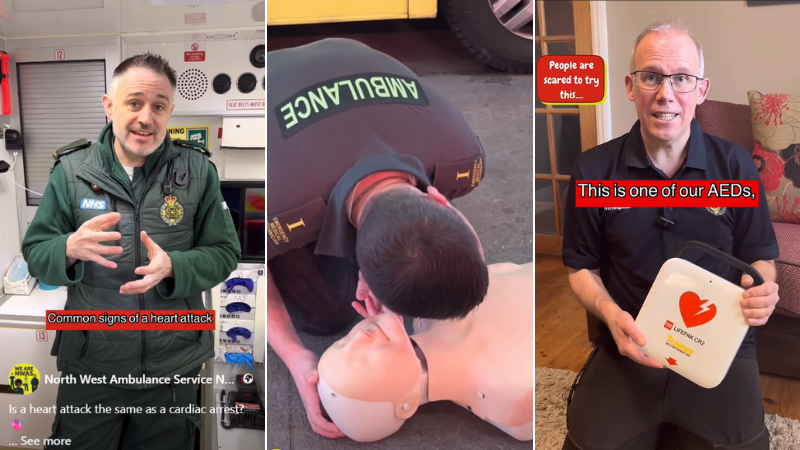
A collage of screenshots from our educational videos featuring three male colleagues. The first is a paramedic in green stood in the back of an ambulance. The second photo is of a male bent over a manikin performing CPR. The third photo is of a CFR holding a defibrillator.

This National Heart Month, we have been using our social media channels to share life-saving advice and highlight that you don’t need to wear a uniform to save a life.

Throughout February, we have published a series of educational videos to help give people the confidence to act in an emergency.

Paramedic Richard began by explaining the difference between a heart attack and a cardiac arrest. Two terms that are often confused, but mean very different things.

A heart attack happens when blood flow to the heart is blocked. The heart is still beating, but the muscle is being damaged.

Common signs of a heart attack include:

  • Chest pain, pressure or tightness
  • Pain spreading to the arm, jaw, neck or back
  • Shortness of breath
  • Nausea or vomiting
  • Cold sweats
  • Feeling dizzy or extremely tired

A cardiac arrest, however, is when the heart suddenly stops beating. A heart attack can lead to a cardiac arrest, so understanding the difference could help save a life.

Emergency Medical Technician Jonny then explained when to start CPR, using two simple questions:

  • Are they responsive?
  • Are they breathing normally?

If the answer to both questions is no, call 999 immediately and begin CPR.

In a follow-up video, Jonny demonstrated how to perform CPR:

  • Kneel beside the person
  • Place the heel of your hand in the centre of the chest and your other hand on top
  • Keep your arms straight and elbows locked
  • Push hard and fast — about two compressions per second
  • Allow the chest to fully rise before pressing down again

We have also been emphasising the importance of early defibrillation. Using a defibrillator within three – five minutes of a cardiac arrest can increase survival rates by up to 70%.

Community First Responder Mark showed just how straightforward it is to use one. Defibrillators provide clear voice instructions and are designed for members of the public to use.

The steps are simple:

  • Open the defibrillator and ensure the person’s chest is exposed
  • Apply the pads as shown on the diagrams
  • Allow the device to analyse the heart rhythm
  • If advised, stand clear and press the flashing shock button
  • Immediately resume CPR

Every minute without CPR and defibrillation reduces the chance of survival. By learning these simple steps and being prepared to act, anyone could help save a life.

If you missed any of our National Heart Month content or would like to keep up to date with our campaigns, follow us on Facebook.

Archive

  • 2026
  • 2025
  • 2024

Contact us

General enquiries

0345 112 0999 To call general enquiries, click this link or dial 0345 112 0999

This number should NOT be used to contact us in an emergency. In an emergency dial 999 immediately or for non-urgent medical advice call NHS 111.

How to find us

Directions to our offices

Alternative formats

Please contact us if you require any information on our website in an alternative format, such as easy read of large print.

CQC Good rating widget

  • Help
  • Privacy policy
  • Accessibility
  • Freedom of Information
  • Contact us
  • Green Room
  • Cookies

© Copyright 2026 North West Ambulance Service NHS Trust. Lovingly crafted by Mixd

Cookie settings

We use some essential cookies to make this website work. We’d like to set additional cookies to understand how you use nwas.nhs.uk, remember your settings and improve our services. We also use cookies set by other sites to help us deliver content from their services.
View cookies
You have accepted additional cookies. You can change your cookie settings at any time.
You have rejected additional cookies. You can change your cookie settings at any time.