



MERIT doctors provide senior clinical advice to commanders during incidents that go beyond normal day-to-day ambulance operations. These can include major incidents, hazardous environments, or situations where decision-making is particularly complex or time-critical.
Rather than delivering hands-on patient care, MERIT doctors provide remote support by offering specialist medical input. This helps ensure that clinical, ethical and legal considerations are built into decision-making, particularly when information is limited or evolving.
Established in 2014, MERIT strengthens the link between frontline clinical care and command decision-making across operational, tactical and strategic levels. The team comprises around 40 experienced doctors from different specialities, including emergency medicine, paediatrics, anaesthetics, intensive care, general practice, and pre-hospital emergency medicine. They operate 24/7 across the North West, and many also bring experience from military, humanitarian or major incident environments.
Introducing Doctor Anisa
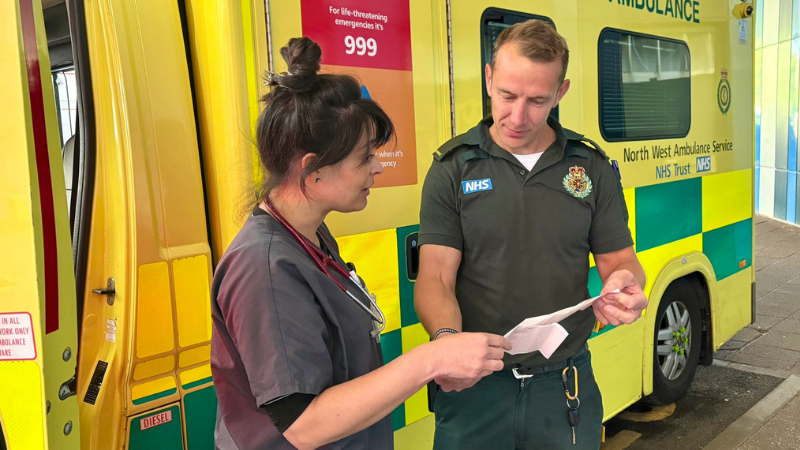
Dr Anisa Jafar is a consultant in emergency medicine and paediatric emergency medicine at Salford Royal Hospital, and a recent addition to MERIT. We spoke to Anisa about her work, her career journey, and what it’s like supporting some of the most complex incidents the ambulance service responds to.
What first drew you into emergency medicine?
Emergency medicine was a bit of a revelation for me early on in my career. I realised quite quickly that I wanted a speciality that gave me variety, pace and a real team environment, somewhere I could do a bit of everything.
But emergency care doesn’t start at the hospital doors. A big part of it happens in the community, and the ambulance service plays a critical role in that. I was really interested in how emergency systems work in different settings and countries, particularly where pre-hospital and hospital care are more closely integrated. MERIT felt like a natural extension of that, a way to use my skills alongside ambulance colleagues in a different environment.
How would you describe a typical day in your job?
A typical day doesn’t exist, which is why I chose the career path I did. One day, I might be working clinically in the emergency department, looking after patients who are seriously unwell or have major trauma, right through to those with minor injuries and illnesses. Next, I could be involved in global emergency medicine work, research or training, or focus on skills development such as airway management and leadership. I also sometimes get the chance to present at international conferences.
MERIT adds another layer on top of that, involving everything from simulation exercises for chemical incidents to observing advanced paramedic practice or learning more about responses to major incidents.
MERIT doctors don’t usually provide hands-on care. What does your role involve in practice?
It’s mainly about gathering information, turning that into useful intelligence, and helping commanders make informed decisions about patient care.
Most of the time, that support is remote, over the phone, radio or Teams, although occasionally it can be on scene. The aim is always the same though, to help ensure the safest and most appropriate decisions are being made during complex incidents.
At what point in an incident would you typically be called?
We can be called very early on, sometimes while an incident is still developing and information is limited. On other occasions, we may be stood down quite quickly once more details come through, which is useful, as it helps us keep practising those early decision-making processes.
We tend to be involved in a wide range of incidents, from fires involving large numbers of building occupants to road traffic collisions with high numbers of injuries.
What helps you manage the responsibility of supporting high-stakes decisions?
You’re never making decisions in isolation, which really helps. There’s always a wider team involved, and that shared responsibility is important.
A lot of it also comes back to experience, both mine and that of others around me. It’s similar to the emergency department, where rapid decisions are made as part of a team caring for critically unwell patients.
Finally, what does it mean to you to work in this way with the ambulance service?
It’s a real privilege to work so closely with colleagues in the ambulance service and to be welcomed into this part of emergency care. It also gives me the chance to work alongside people I wouldn’t usually meet in my day-to-day role.
The breadth of experience, skill and professionalism across NWAS is genuinely impressive, and I’m constantly astounded by the level of expertise within the service. For me, it’s really energising to be using the emergency medicine skills I have developed clinically in a different way, as there is a huge amount of transferability.
This article was featured in the latest edition of our Your Call magazine.