



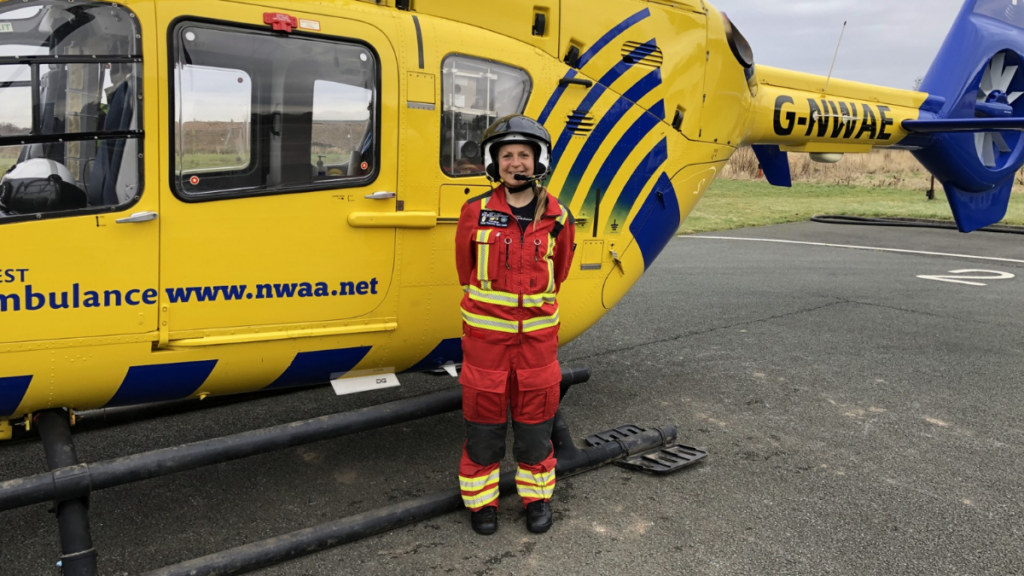
“It makes me feel super old now,” she laughs. “I joined as a trainee ambulance technician in 2004 and completed all my training in-house.”
After qualifying as a paramedic in 2008, Caroline spent several years developing her clinical skills on the road before taking on a new challenge.
Taking to the skies
In 2011, Caroline successfully applied to become a helicopter emergency medical service (HEMS) paramedic with the North West Air Ambulance Charity. The selection process was rigorous, involving fitness assessments, map reading, IT tests, written and practical medical examinations, followed by an interview.
“It was a really competitive process, and at the time the role was only a two-year secondment,” she explains. “Every two years, I had to reapply and go through the whole process again.”
It wasn’t until 2018, when she became a senior paramedic, that her role became permanent.
When Caroline first joined the service, she was the only full-time female HEMS paramedic.
“Over the years we’ve seen more women join the team, which is fantastic. There are still challenges, particularly around balancing the role with family life, but the profession is becoming much more diverse.”
How HEMS has evolved
The air ambulance service Caroline joined is almost unrecognisable compared to today.
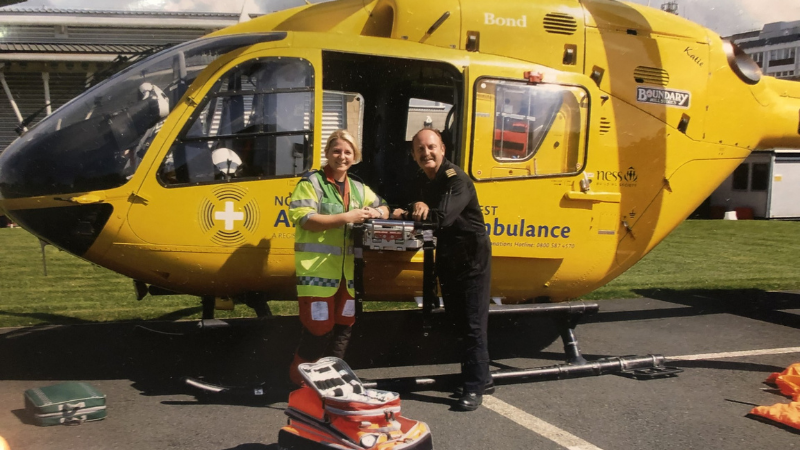
“When I started, there were only six paramedics working on the service and no doctors. We had two helicopters, but one only operated five days a week and for limited hours.”
Today, the service operates three helicopters, supported by a multidisciplinary team of critical care paramedics and doctors, delivering advanced interventions that simply weren’t possible two decades ago.
“The growth has been incredible. We can now perform advanced procedures, carry blood products, undertake pre-hospital emergency anaesthesia and deliver critical care interventions at scene. The difference in what we can offer patients today is huge.”
A typical day
While many people imagine the excitement of flying, Caroline explains that every shift begins with meticulous preparation.
Crews check aircraft equipment, medications, blood products and response vehicles before carrying out a comprehensive team briefing covering weather conditions, operational risks and service availability.
“People think we’re waiting around for jobs, but there’s always something to do. Whether it’s training, equipment checks, clinical governance work or supporting the wider team, every day is busy.”
The role also requires paramedics to adapt to a very different working environment.
“When you first start on the helicopter, it almost feels like you’ve forgotten how to be a paramedic. You’ve got the noise, the helmet, multiple radios and so much going on around you. It can feel overwhelming.”
But once settled into the role, Caroline says it’s a privilege unlike any other.
“It’s the best job in the world. We get to fly across the North West and support people during some of the most critical moments of their lives.”
A moment that stayed forever
Asked about a standout moment from her career, Caroline recalls an incident involving an eight-year-old boy who had fallen approximately 40 feet from cliffs onto a beach below.
With the tide rapidly coming in and no safe access for land crews, the helicopter crew were the only option. The aircraft had to remain running throughout the rescue and the team had just minutes to stabilise and evacuate the child before rising water made departure impossible.
“It was incredibly intense. Everything was happening at speed and we were working against the clock.”
Years later, Caroline attended a family wedding and struck up a conversation with another guest. To her amazement, it turned out to be the boy’s mother.
“She told me he had survived and was doing well. He’d had a long recovery, but he was living his life. It was one of those moments you never forget.”
For Caroline, it highlighted one of the most rewarding aspects of the profession.
“So often we never find out what happens to our patients. To hear that he had gone on to live his life was really special.”
Looking to the future
Having witnessed enormous changes throughout her career, Caroline believes the next 20 years will see paramedics continue to expand their clinical capabilities.
“We’ve evolved so much already, and I think we’ll continue to gain new skills, new medications and new opportunities to deliver even better care.”
“There’s so much room for growth. The profession has changed massively during my career and I think the next 20 years will be just as exciting.”