



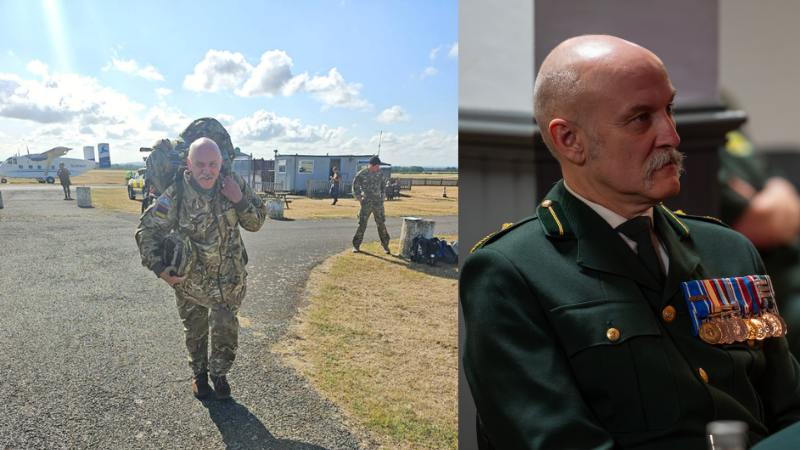
Outside of his day job, Matt is a warrant officer class 2 (WO2) in the Army Reserve. He serves with 144 Parachute Medical Squadron, the Army Reserve’s only airborne medical unit, which is part of the 16 Air Assault Brigade. During his service, he has completed tours in Bosnia, Iraq and Afghanistan.
Matt’s career in the Territorial Army started in 1994, as an opportunity to experience the challenges of military life. After passing the pre-parachute selection, he qualified as a military parachutist and more than 30 years later, he’s still jumping. Although the jumps have got less stressful, he admits that the landings are getting harder with age. Despite this, he has no intention of giving up his title of the ‘oldest in date paratrooper’ in the brigade any time soon.
A strong emphasis on medical training in the army played a key role in Matt’s decision to join the ambulance service. The two roles, he says, complement each other well, “The education, training and experience from one is directly applicable to the other,” he explains. “I think that’s why many military people are drawn to the ambulance service.”
Matt sees striking similarities in how the work is carried out. “In both roles, you’re part of a small team, usually without direct management, working towards a common goal. Although there is guidance on how incidents are managed, the details are ultimately determined by the person on the ground.”
He reflects on his time in Afghanistan as being both the highest and lowest points of his time in the reserves. Using both his military and clinical skills to their fullest, he says he experienced things that have stayed with him. However, it’s a career he would still highly recommend to others because throughout his three decades in the reserves, he has gained invaluable experience.
Matt says his experience comes from the variety of work available in the military.
“Just last year, I was part of the test team that trialled the A400M aircraft for parachuting. I took part in an exercise in Michigan as a flight paramedic in a Blackhawk helicopter for two weeks. I also had the opportunity to parachute into Sweden and secure a stretch of motorway ahead of an American military plane landing on it.”
Matt now holds a strategic clinical role within NWAS, and he uses his position to contribute to national guidance. “I really value the influence I can have,” he explains, “especially working on things like the JRCALC clinical guidelines for resuscitation, which I’ve helped to write and review.” Although his role may have changed, the reasons for joining the ambulance service haven’t. He still enjoys going out and helping patients.
While the army and the ambulance service are very different, Matt works as part of our Armed Forces Network to support all staff members within our armed forces community. Emphasising the importance of the network, he says: “It is a point of focus for reservists, like me. It ensures NWAS understands the benefits that reservists bring to the ambulance service and how they can support us in our second career. The network also supports ex-regular service people, ensuring the skills and experience they have developed in their military careers are recognised and understood.”
We hope you have enjoyed us sharing Matt’s story to commemorate Armed Forces Day.